Scope: eight hazards, 187 sourced rules
Every sentence Aynıyer produces is tied to a source. Below are the hazards the engine produces today, how each one changes the protocol, and the limits of the sources.
The five shapes of the protocol
Adding a hazard is not duplicating a template. In terms of what a person should do, the eight hazards fall into five different shapes — and two of them say the exact opposite of each other.
| Shape | Hazard | What the protocol says |
|---|---|---|
| Immediate, outside the building | earthquake | During the shaking, drop, cover, hold on; then leave the building and stay in an open area. |
| Immediate, inside the building | tornado | Not out but in: the lowest floor, a space with no window facing outside. |
| Directional (you move away) | flood · wildfire · landslide | The hazard has a direction; you move away from it and leave the area. |
| Prolonged (you wait it out) | winter storm · extreme heat | Lasts hours to days. In a winter storm, moving is forbidden; in heat, a cooler place is sought. |
| No sheltering (you get out) | house fire | The one hazard with no notion of sheltering: get out and do not go back in for any reason. The meeting place is right in front of the house, not at district scale. |
This distinction is the product’s most expensive lesson: in a winter storm, the reflex to “go to the meeting place” makes people do exactly what the sources forbid. That is why the engine builds the meeting sentence separately for each hazard.
What a hazard plan looks like
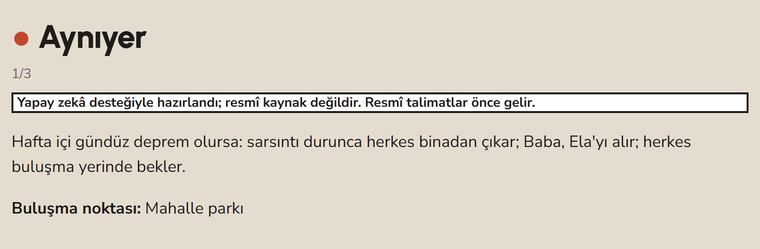
All eight hazards come out in the same form: a one-sentence protocol, a meeting point and a source trail. Below is the first side of a real fridge sheet produced for an earthquake.
Sources and confidence level
Every rule is tied to an official page that was actually read, and it appears in the plan together with its source. If two independent institutional sources carry the same fact, the rule counts as verified; if there is only one source, it says secondary.
- AFAD — earthquake hazard map and preparedness pages
- Ready.gov / FEMA — publicly available disaster preparedness texts
- NOAA · NWS · SPC — winter storm and tornado safety
- USFA (a FEMA unit) — house fire: smoke alarm, escape plan, get out and do not go back in
- CDC — extreme heat and heat illness
- USGS — landslide warning signs
limit Thresholds that come from the United States (for example 32 °C for extreme heat) are written with a note that they are a US definition. If an official threshold for Turkey could not be verified in this corpus, none is invented — it says “could not be verified”. The product principle: what you cannot reach is not called “nonexistent”.
What we deliberately left out
The absence of a feature is not always a shortcoming; some of them are decisions.
| None | Why |
|---|---|
| Publishing official-looking warnings | Cell broadcast is a state monopoly. We are not a warning authority; we translate warnings. |
| Continuous location tracking | We do not collect location in calm times. Even in incident mode there will be a visible indicator and a time limit. |
| AirTag / Find My data | There is no official API; reverse engineering violates the terms of service. |
| Free-form AI text | The model does not build a hazard model. AI only simplifies existing text; it cannot add a step, a number, a meeting place or an evacuation decision. |
| Structural building assessment | Building age affects evacuation priority; saying “your building is sound” is an engineering statement, and we do not make one. |
The plan itself decays
A child changes school, a source page is updated, an instruction is withdrawn. The freshness engine keeps track of which corpus version a plan was produced with, and says “review this” for three reasons: when a rule is withdrawn, when content is updated, and when time passes.
If an instruction turns out to be wrong, the rule is switched off and the plans produced with it are flagged immediately. A withdrawal is never done quietly.