How it works
The plan does not come out of a text generator. The household’s information passes through a deterministic decision table; every step is tied to a sourced rule, and wherever that is not possible the plan writes “missing”.
The plan is built in five steps
-
Household profile — 7 steps, 10 minutes
Who lives there, who is where on a weekday during the day, the district and floor of the home, whether there is a vehicle, how you heat the home, whether there is cooling in summer, whether there is a basement or a windowless inner room, and where the house sits on the slope.
We do not ask for your real name — a nickname is enough. We do not ask for a full address — a district is enough. Saying “I don’t know” to any question you cannot answer is a valid answer.
-
The decision table — where the protocol is built
The engine is not AI but a rule table with a fixed order. Every rule is a condition and an action: “there is a pickup assignment and no known obstacle on the road → go and pick up the dependent person.” The same input always produces the same plan.
The table changes with the hazard. In a winter storm the movement rules come before the pickup assignment: setting out on an icy road to pick up a child is movement that the sources forbid.
-
Pickup, backup, meeting
Everyone who cannot move on their own is assigned someone to pick them up and a backup. If there is nobody suitable in the household, this is written as missing — it is not quietly left blank.
Meeting places come in three tiers: primary, secondary and out of town. An official assembly area is not assigned automatically; because the open data set could not be verified, we do not invent a place.
-
Paper output — first class
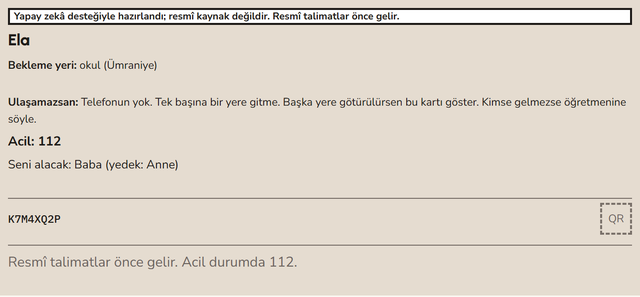
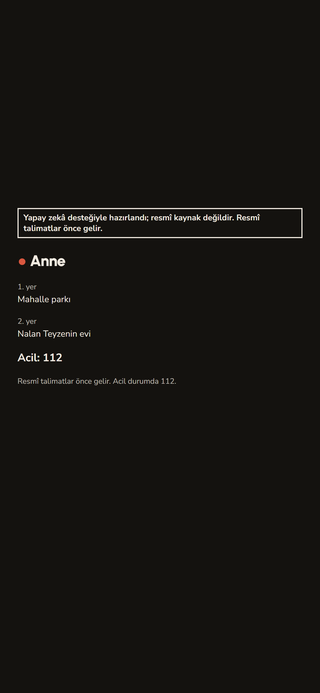
Fridge sheet (A6), child card (85×55 mm), wallet card and lock screen image. Readable in black-and-white printing, the smallest type never goes below 10 point, and overflow is measured automatically.
This is the only layer that works without electricity and without internet.
-
Publication gates
Every text produced passes a content safety check before it reaches the user: the “never say” list, phrases that promise absolute safety, consistency of numbers and polarity, and schema limits.
Simplification with AI is switched off in this version — the engine above produces the plan from start to finish. Even when the layer is switched on, the model cannot produce new information: it only simplifies an existing sentence, and its output passes through the same gates. If the number of steps, the thresholds or the prohibitions change, that line is rejected and the engine's own text is printed.
What you end up with
The output of the five steps is not a screen but paper and pocket. What you see below is not a drawing: the wallet card and the lock screen image of a real earthquake plan produced by the engine. The production stamp is on every plan.
The plan’s gaps are not hidden
The product’s most frequent answer may be “missing”, and that is not a defect but a design choice. A real example: in a winter storm, if someone who needs care is alone at home, the responsible adult cannot set out while the storm lasts. The plan does not hide this — it asks for a helper within walking distance to be named, and writes that gap out plainly.
Verification
The plan engine is measured with a family simulator: different household compositions, times of day and world scenarios are run for 24 hours, and violations of the invariants are looked for (“nobody passes along a closed road”, “nobody enters a building that must not be entered”).
The tool itself is tested too: deliberately broken versions of the model are run, and each break is required to turn at least one invariant red. A break that is not caught means the tool is blind to that class of error, and the gap is recorded in writing.
limit The simulator is not proof of safety. The accuracy of the model depends on a disaster expert review, and that review has not been done yet.